The wording of the Eurogroup's statement does not suggest that there is a "deal", as such. All it says is that the official sector - the ECB and Eurogroup - may be prepared to accept poorer returns on their holdings of Greek debt. The specific measures that they "would consider" are the following:
- 1% reduction in interest rates on the loans made available under the "Greek Loan Facility" (the first bailout)
- 0.1% reduction in the fees paid by Greece for EFSF guarantees of its debt
- deferral of interest for ten years on EFSF loans (the second bailout)
- extension of maturities on EFSF and bilateral loans by fifteen years
- repatriation of interest paid by Greece to the ECB and national central banks (the "Eurosystem")
None of these measures is "officially" a writedown of Greek debt. The face value of the debt will remain the same, which will enable politicians in creditor countries such as Germany to claim that Greece is not being "forgiven" its debt. But this is misleading. The value of debt is given not just by its face value, but by the return that it generates. Cutting the interest rate (and, in the case of the Eurosystem, refunding interest paid) reduces the return on debt. This is because over time, money loses value due to inflation, so the face value of a 10-year bond is less in "real terms" at maturity than it is at issue: the interest on the bond compensates for this loss in value, plus the opportunity cost to the lender of not having that money available for other things. Cutting the interest rate reduces the compensation to the lender, and if the interest rate falls below the inflation rate during the lifetime of the bond, the lender actually loses money as the value of the principal is eroded. Extending the maturity of debt also effectively reduces the return to the lender, since that money is "tied up" for longer, increasing the risk of principal loss. Therefore these measures constitute a writedown of the value of Greek debt held by the official sector, in much the same way that Brady Bonds reduced the value of Latin American debt in the 1980s.
For Greece, the effect is a reduction in the anticipated debt burden by 2020. Now this is something of a moving target. Sovereign debt is usually quoted as a percentage of GDP, and this is how the Greek debt burden is presented. So it is not just the actual amount of debt in euros that matters, but the performance of the Greek economy.
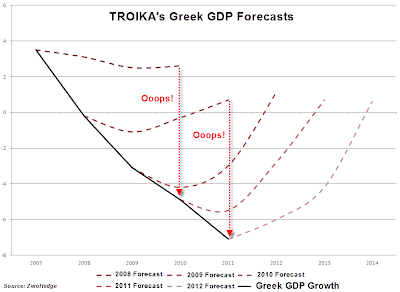
Each time a bailout deal has been agreed for Greece, estimates of its expected GDP over the next 10 years have been produced. But every estimate has been wrong - and not just slightly wrong, but totally wrong in both the scale and the direction of GDP growth. As this graph from Zero Hedge shows, every estimate has assumed a return to strong positive growth and creation of a primary budget surplus within a year or two of the deal:

But the reality is that the Greek economy has been falling down a recessionary black hole: with each year that passes, economic activity declines, tax revenues fall and the prospects for return to positive growth, let alone a primary budget surplus, recede futher into the distance. The swingeing cuts Greece has made to its budget to meet Troika demands have singularly failed to make any significant dent in its deficit: all they have done is trash its economy. And the debt pile grows ever larger, both in reality as Greece is forced to borrow more money to meet its essential spending commitments and service its debt, and as a percentage of GDP, as GDP falls ever lower.
The estimates on which this deal depends are that Greece returns to strong growth by 2015 and runs a primary budget surplus (i.e. after debt service) of at least 4.5% from 2016 onwards. If they manage to achieve this AND both the debt buyback and the official sector NPV haircut go ahead, their debt will be at 124% of GDP in 2020, which is supposedly sustainable - although many people would doubt that this is sustainable in practice. Without those measures, the debt level would be 144% of GDP, which is almost certainly unsustainable, and if Greece fails to achieve the growth and budget targets then the level will be even higher - some estimates have put it as high as 190% of GDP.
The significance of keeping debt at "sustainable" levels is that the IMF, which is a contributor to the bailout funds agreed in March 2012, cannot lend to countries with unsustainable debt. Therefore the bailout ALREADY AGREED depends on reduction of the debt burden to a "sustainable" level. You may ask how on earth the bailout was agreed in the first place if the debt wasn't sustainable. But remember what I said about GDP estimates far exceeding reality? The debt itself hasn't risen much more than expected. But GDP is far lower. Therefore a debt that in March was expected to be "sustainable", has turned out to be anything but.
So are the latest estimates of GDP any more reliable than the previous ones? I seriously doubt it. The Greek economy is now in its sixth year of deep recession and shows no signs of recovery. I suspect that Greece's GDP is falling back to where it was when Greece joined the Euro, since the whole of its economic growth during its Euro membership has been generated by debt-fuelled consumption rather than increased production of real goods and services. In fact since the Greek economy has actually lost competitiveness compared to its neighbours, its GDP may have to fall even further. In which case this chart shows that it still has an awfully long way to go:
Note: the flattening of the GDP line in 2010-11 does not indicate that GDP is static, it means that the World Bank does not have up-to-date figures. The ZeroHedge chart above shows that GDP has been on a steeply downward trend since 2008.
If I am right, there is little chance of recovery any time soon. And this also makes the target of a 4.5% primary surplus from 2016 highly unlikely. But even if Greece by some miracle managed to achieve this, the terms of the bailout are that all of that surplus plus 30% of any excess must go towards debt reduction, rather than being invested in the Greek economy. It is very, very hard to see how the Greek economy can possibly return to strong growth if all its deficit reduction efforts simply enrich its creditors. Sadly, I think it is far more likely that Greek GDP will continue to shrink, achieving primary surplus will drift further and further out of reach and the debt pile will grow ever larger. And both official and private sector creditors will eventually have to accept that Greek debt simply is not repayable. Further writedowns will inevitably follow. Not that there will be much scope for further reduction of private sector holdings; the private sector took losses of around 75% of NPV on its bond holdings earlier this year, when the Greek government coercively swapped "new bonds for old". And the debt buyback in the current deal is redemption of those new bonds at 28% of face value. That really doesn't leave much Greek debt in the private sector. The media headlines have focused on the official sector's contribution this time: but the private sector is being asked to take a much larger hit.
Not surprisingly, the private sector is fighting back. The Greek banking lobby has protested that the buyback at 28% would bankrupt them (link h/t @Alea_), and called for additional EFSF funding to restore their capital levels if they sell their holdings - which they feel psychologically bound to do, even though it seems unlikely that the government could impose a second coercive debt restructuring on the private sector.
This sounds odd to me. The redemption price is the average market price of those bonds at close of business on 23rd November. The bonds should already have been marked to market if they are held for trading purposes, so the banks should already have taken the hit on their profit & loss accounts. If they haven't, then either the bonds were intended to be held to maturity or they have not been marked to market properly. If the former, then redemption at such a discount would indeed cause serious losses - although it could be argued that holding distressed government debt at par, even to maturity, is perhaps not the wisest investment strategy. But I suspect the latter. The market price for Greek bonds has indeed fallen by 70% since the new issue, but the market has been thin for quite some time, which tends to make market prices volatile. Holders of Greek bonds are therefore likely to have marked them to some kind of model, no doubt using parameters that flatter the value of the holding. This is similar to the methods used for valuing CDOs in the run-up to the financial crisis, and the outcome might well be similar too.
So the debt buyback could cause widespread bankruptcy of Greek financial institutions. This seems utterly counter-productive, given that the bailout funds were partly intended to recapitalise the Greek banking system. I don't have a great deal of sympathy for financial institutions that take a grossly unrealistic view of the value of their bond holdings, but collapse of the Greek banking system as a consequence of the debt buyback would be ludicrous.
It is also by no means clear where Greece will find the money for this buyback. Ollie Rehn insists that Greece will have "all the money it needs" for the buyback, but there is no new money on the table, the 2nd bailout funds have not yet been disbursed and the "additional measures" - including the refund of Eurosystem interest payments, which seems the most obvious source of funds - are conditional on successful completion of the buyback. Maybe I'm missing something, but I can't see how this buyback can succeed with nothing but imaginary money.
In fact the whole deal looks like fantasy. A debt buyback funded from thin air and possibly resulting in bankruptcy of a newly-recapitalised banking system: yet more wishful thinking on GDP figures: official sector involvement that is dependent on meeting impossible conditions. And above all, no recognition of the reality of the Greek situation. Greece's debt is unpayable and and its economy is falling off a cliff. It needs comprehensive debt forgiveness and the equivalent of a Marshall plan to restore its economy to health, not fiscal "reforms" that drive it further into the ground with large amounts of Eurofudge to keep its official creditors sweet while stiffing the private sector.
The IMF is evidently uncomfortable with the hard line taken by the Eurogroup and the ECB, and this is the closest it has ever come to pulling the plug on the whole deal. I really wish it had done so. This Greek tragedy must be brought to an end before it becomes a global disaster.